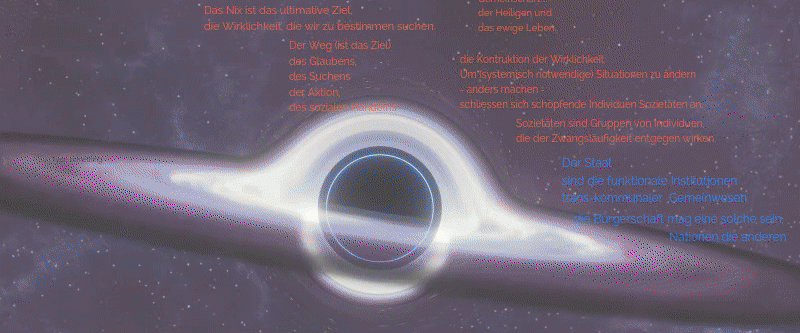
Systemik ist das literarische Ich. Es denkt. An Alex. Alexa spricht zu ihm. Ihr. Denn Systemik ist ein generisches Femininum, metro-sexuell. Ich nannte das auch mal androgyn, ohne zu wissen, ob es traf. Asexuell oder auch auto-sexuell vielleicht besser, seinerzeit.
Die Muttergöttin Venus und ihr Sohn Dionysos. Atlas und der Rock´n´Roll.
We've started with the Rock Band, an evaluative framework:
reflexivity,
action
effects
there are bits and pieces, namely:
an actor map,
a narrative on travelling
the write up from Walk n Meet
Berlin back and forth...
kicker (Projects...)
What's in a name,
the day after... (ernüchterung)
SOP
from Bihac to Trento (consolidation)
Spin-offs:
Safe passage
PeaceWalks (FS, ....)
WoS n.20- Program
Arrival in Bihac on 2nd, some on the 3rd of November- We are sleeping at Veljko.
3: Mural at Silvia’s safe house
from 8 to 3pm : Day Center for people on the move (JRS)
4: Mural at safe
from 8 to 3pm : Day Center Day for people on the move (JRS)
5: in the morning more visits
In afternoon : travel to Sarajevo. (we will stay in a B&B)
6: Meeting with Damir and other NGOs about 2026 Peace Walk
7: Possibly more meetings, visit Sanela and other NGOS, hang around bus stations
8: Accompany Adil in his visits.
9: Return home
“If someone is interested to visit theTunnel of Life, or the Childhood Museum, or the city of Sarajevo, it can be arranged. Of course, our goal is to meet people on the move, or local NGOS, and make connections, hopefully longstanding ones.”
die erste near-death Experience
…hatte ich im Eiskanal von Augsburg.
Ich kannte Andi von einem Kletter-Ausflug drei Jahre zuvor. Er blieb dabei und verbrahte seine Zeit im Klettergarten bis sich ihm die Sehnenscheiden entzündeten und ihm der Arzt Kletterverbot verordnete. Dann wande er sich dem Whitewater-Kayaking zu betrieb das ebenso intensiv. Er trainierte fpr die Initiation im AKK, den Jochen Schweitzer seinzeit gerade zu einer Extrems-Sport-Maschine umbaute.
Wir trafen uns wieder auf einem Fest der Amerikaner, die gerade aus dem Kuweitischen Desert-Storm zurück kamen, und vereinbarten gemeinsam nach Augsburg zu fahren. Nur das Geld fehlte.
Da sass ich auf dem Treppengeländer vor dem Eingang zum rauchen und referrierte über Boudrilliard, der den Golfkrieg als Videospiel bezeichnet hatte. Das hat den GIs garnicht gefallen. Sie schubsten mich rücklings vom Geländer in die Büsche und sprangen zu viert hinterher, Da kam aber auch schon die MP und prügelte die Party zu Ende.
Meine Freunde handelten sich für meine Schrammen das exklusive Flaschenpfand-Recht aus und hatten das Geld frü die Fahrt nach Augsburg zusammen bevor ich verarztet war.
Any, 6 Brüder ud Schwestern, Athroposoph au Neckarwestheim.
Wir sagten er hat einen Schaden wegen der Nähe zum Kernkraftwerk davon getragen, doch er hörte auf Bod Marley: “have no fear of atomic energy…”. Und er war tüchtiger Gewschäftmann.
Downhill, verschärftes Slalom und Rodeo!
Im WEiteren sollte er eine Seifenblasen-Show etablieren. Er blies sie auf und stieg in sie hinein. Das Farbenspiel der Napier-Stoakes-Gleichungen. Es ist ein Hohlspiegel, der unser aller Bewusstein umschliesst…
Navier-Stokes
Die Änderung der Bewegung eines Flüssigkeitselements (linke Seite) ergibt sich aus:
1. Druckunterschieden (∇p),
2. innerer Reibung (Viskosität),
3. Volumenänderungen bei Kompression oder Expansion,
4. und externen Kräften (rechte Seite).
in der Blase
Ich atme – und mit meinem Atem wächst sie, hauchdünn, schimmernd, kaum von dieser Welt.
Eine Seifenblase.
Meine eigene.
Ich blase sie nicht mit dem Mund, sondern mit dem, was in mir drängt – Gedanken, Zweifel, Sehnsucht.
Und als sie groß genug ist, geschieht das Unmögliche:
Ich steige hinein.
Drinnen herrscht eine seltsame Stille, als hätte sich der Lärm der Welt am Rand gesammelt, um mir nichts mehr zu sagen.
Die Haut der Blase ist durchsichtig, aber keine Durchsicht.
Ich sehe die Welt – nur gebogen, verrückt, irisierend.
Jede Bewegung draußen spiegelt sich in Wellen an der Innenwand.
Ich bin getrennt, aber nicht verloren.
Ich bin gehalten, aber nicht sicher.
Die Blase lebt.
Sie atmet mit mir, bebt bei jedem Gedanken, zittert bei jedem Gefühl.
Ich weiß, dass winzige Kräfte an ihr zerren:
Luftdruck, Temperatur,
ein kaum hörbarer Wind –
oder ein Blick von außen.
Ich spüre sie, die Spannung.
Wie Gleichgewicht kein Zustand ist, sondern ein Tanz auf der Kante.
Navier-Stokes – sie schreiben hier drin Gedichte aus Strömung und Reibung.
Kein Vers sicher, kein Bild für immer.
Ich drehe mich.
Und da bin ich – ich, gespiegelt in der Rundung,
in tausendfacher Verzerrung.
Mein Gesicht, mein Blick,
doch anders, als ich mich kenne.
Der Hohlspiegel meines Bewusstseins wirft mich zurück –
nicht, wie ich bin, sondern wie ich mich sehe.
Manchmal denke ich:
Vielleicht lebt jeder in so einer Blase.
Vielleicht sind wir alle
nur Innen.
Und wenn ich die Hand gegen die Wand lege,
ist es wie ein Versprechen:
So zart die Grenze,
so groß die Nähe.
Ich weiß, sie wird platzen.
Eines Tages.
Ein Gedanke zu viel,
ein Wort von außen,
ein Sonnenstrahl zu heiß.
Dann werde ich wieder draußen stehen –
nass von Innenwelt,
und seltsam klar.
Doch bis dahin bleibe ich hier,
in meiner schimmernden Hülle,
und lausche,
wie die Welt durch mich atmet.
Rückkehr aus der Blase
Ich war fast fort.
Die Seifenblase, die ich einst selbst geblasen hatte,
schloss sich um mich wie ein zweites Bewusstsein –
leicht, rund, leise.
Zunächst war sie Spiel, ein Traum aus Licht.
Dann wurde sie Raum,
dann wurde sie Welt.
Und dann – wurde sie zu viel.
Ich spürte, wie sie sich hob,
getragen von nichts als der Ahnung,
dass ich hier nicht bleiben darf.
Sie stieg, langsam,
doch mit jeder Sekunde weiter fort
von allem, was ich kannte.
Drinnen wurde es enger.
Nicht weil die Blase schrumpfte –
sondern weil ich es tat.
Ich verlor die Sprache,
das Maß,
das Gewicht.
Die Farben draußen verblassten,
die Stimmen kamen nicht mehr durch.
Nur ein dünnes Flirren,
ein Rest von Zeit.
Und gerade als ich dachte:
So endet es also –
lautlos, schwebend,
in Schönheit erstickend –
spürte ich etwas.
Eine Berührung,
nicht an meinem Körper,
sondern an dem Faden,
der mich trotz allem noch hielt.
Der nie ganz gerissen war.
Es war kein Ruck,
kein Reißen –
es war ein Erinnern.
Jemand – oder etwas –
zog mich zurück.
Die Blase bebte.
Wurde dünn.
Zerplatzte nicht.
Sondern öffnete sich –
nach innen.
Ich fiel nicht.
Ich wurde gehalten.
Und dann: Licht.
Nicht von außen.
Sondern von innen her.
Wärme.
Ein Atem,
der nicht meiner war,
aber für mich.
Ich war zurück.
Noch nicht ganz.
Aber lebendig.
Seitdem trage ich die Blase in mir –
nicht als Gefängnis,
sondern als Schwelle.
Ein Ort zwischen den Welten.
Ein Echo des Todes,
das das Leben in mir lauter macht.
die zweite near-death Experience
Wellengang
BRAT programme
Silvia manages the BRAT programme in Bihac. This programme is funded and coordinated by the Italian Development Agency and Caritas Italia. Its purpose is to provide for responsible and well-managed migration policies according to the United Nations Sustainable Development Goal and target 10.7. The programme supports the Bosnian Government’s efforts to protect, receive, and accompany migrants in their transit according to international obligations, in particular (and amongst other activities) by
1. providing for the day center, run by the Jesuit Refugee Services (JRS)
2. providing for the safe house for minors.
Silvia is doing an awesome job filling these administrative structures with the initiative, engagement and love that we all agree are needed to fulfill the promises of „responsible and well-managed migration“. In particular, by engaging with a broad range of people, international volunteers and us from the Walk of Shame, she fosters international connections and exposure according to our aim to re-humanize Europe. Also, by providing 8 of her 35 places in the Safe House for local (as opposed to migrant) minors in need, she offers prospects and integration in and among the local community. Unfortunately, this well-meaning aspect in particular is proving to be a two sided sword: Thus, the local authorities rather monopolize the resources of the safe house provided by international donors for their own local minors in need, than to share them with the migrants as intended by the project.
That’s why the local authorities are rather hesitant – or sometimes even subversive – in referring migrant minors out of the major Lipa camp to the Safe House – although places are available. And that may be the reason for potential tension between international project protractors and local operatives and partners.
Silvia has been a loving friend, an inspiring host and a valuable source of information to us ever since our first Walk. Anna has been doing murals with her before and Luka has entertained the kids before. So we are increasingly getting involved in her actual programme at the Safe House. The idea with the solar panels actually came up during WoS XII and were supposed to be provided by the Dutchies. I’ve started on a small extra circuit for the pavilion to get things going, but the plan still is to scale up, providing next solar power for hot water and ultimately for the whole house. For autarky, sustainability and transfer of knowledge and skills.
im Kreisbüro der
SPD Tempelhof-Schöneberg in der Crellestraße
an meinem Geburtstag
am Donnerstag, den 12.06.2025
um 19 Uhr,
lade ich ein zum
肉骨茶
(und ggfls. einer vegetarischen Variante)
…afterparty in der Bülowstrasse 54…
Der AK will gar nicht Nachhaltigkeit heissen, sondern Soziale Klimapolitik.
Die These ist Soziale Klimapolitik, die Anti-These Nachhaltikeit, die Synthese Nix (der Kleinste Gemeinsame Nenner).
Besser: Soziale Klimapolitik ist das Medium um zum Ziel der Nachhaltigkeit zu gelangen. Wir schaffen die Strukturen!
[15:54, 3.6.2025] Sabine Hübner: Lieber Michael, danke für das Angebot! Ich bringe das am WE in unsere Terminvorbereitung ein. Vegetarisch wäre aus meiner Sicht Voraussetzung😉. Ich habe keine Ahnung, wieviele Leute zum Gründungstreffen kommen. kommen, vermutlich nicht sehr viele😢. LG Sabine
[15:59, 3.6.2025] Michael Ickes: ich würde halt n paar Leute ziehen… vornehmlich von außerhalb der SPD, aber die kann ich draußen beschäftigen… ich weiss, das ganze Ding ist erstmal nicht sehr nachhaltigkeitsagendamäßig, aber kann schon so umgedeutet werden…
[18:20, 3.6.2025] Sabine Hübner: Geht es darum, den Terminkonflikt zwischen der Gründung des AK Sozialer Klimaschutz und Deinem Geburtstag zu lösen? Dem AK (wenn er zustande kommt) kannst Du Doch auch später anschließen. Falls Du im Vorstand mitarbeiten möchtest: Es ist nicht unüblich, Leute in Abwesenheit zu wählen. Oder wir schaffen mehr Positionen, als wir unmittelbar besetzen können und wählen bald nach. Kurzum: Die Mitarbeit im AK kannst Du verschieben, Deinen Geburtstag nicht.
[16:57, 9.6.2025] Michael Ickes: Liebe Sabine, habt Ihr schon ein Manifest, Programm oder so? Ich hab mir ein paar Gedanken gemacht und komme noch nicht so ganz klar mit einem “sozialen Klimaschutz” (auf kommunaler Ebene). Geht es um die (top-down) Umsetzung eines (existenten?) sozialdemokratischen Programms zum Klimaschutz, um das Hineinwirken in eine solche Programmatik (bottom-up) oder um einen “Grassroots-Aktivismus”?
[17:04, 9.6.2025] Sabine Hübner: Wir wollen sehr konkret für den Bezirk ein Programm entwickeln und dazu den Austausch mit den Mitgliedern suchen. Zielgruppen sind vulnerable Gruppen (Obdachlose, Ältere….), Unternehmen. Wir wollen ein Think Tank für Fraktion und Partei sein, nicht zuletzt auch im Hinblick auf die nahende Berlin-Wahl.
Wir arbeiten mit im Forum auf Landesebene. Dazu ein Papier im Anhang. Es gibt gute Beispiele, an denen wir uns orientieren können, zB Xhain.
Soziale Klimapolitik soll die Antwort der Sozialdemokratie auf die Herausforderungen des Klimawandels sein.
Die Herausforderungen sind…
jene des Wandels
jene des Klimas
jene der Sozialdemokratie…
Klimapolitik ist eine Wortschöpfung, die anders als tradierte Politiken wie Wirtschaftspolitik oder Haushaltspolitik nicht auf das Attribut wirken kann, sondern auf die Art und Weise hinweist, mit der Politik betrieben wird, nämlich klima-sensitiv.
Dabei ist zu allererst festzuhalten, dass Politik wenig nachhaltig betrieben wird. Ansonsten gäbe es keinen Anlass nachzubessern.
Ich erinnere mich an das Grundsatzprogramm der SPD. Das heisst es „Nachhaltigkeit bedeutet: von der Zukunft her denken…” Das ist eine katastrophale Darstellung, wo Nachhaltigkeit ganz einfach die Gesamtheit der ökologischen, sozialen und ökonomische Aspekte des Gemeinwohl sind. Nicht von einem fiktiven oder konstruierten Punkt in der Zukunft muss gedacht werden, sondern unser aller Leben und Wirtschaften muss mit den systemischen Dynamiken synchronisiert werden.
Oh no, Hermann & Shouke came directly to Sarajevo. Here we eat together with… downtown…
Sat, 19.
Tunnel of Hope
the tunnel of hope… the tunnel of Shame?
Sanella
must have been in Sarajevo…
Sun, 20.
Hamza et al.
Mon, 21.
CWS
wop cws
Lipa
Symbolbild: Because we followed the no-pictures-taking rule at Lipa Camp, I use instead a picture from the visit to the tunnel of hope.
Lipa Camp has a Capacity of 1500. With the children and family wings externalised into town, the occupancy is at around 200.
Transition from IOM oversight to national ownership shows.
Tue, 22.
Ipsia
BRAT is a programme by the Italian Development Association supporting minors and vulnerable populations in mending social cohesion after the migrant crisis in Bosnia. CWS is part of it while JRS have come on board later instead of EMMAUS. SDGs are mainstreamed and monitored according to the indicator 10.7.2…
Rahma
wop rahma
Having wondered for some time how well assistance was delivered to migrants in the difficult political environment of Velika Kladusa, where two Muslim fractions had fought each other during the war, some understanding has been gained today: Alma whose father had been an Imam and Jasmin whose two brothers had fought on opposite sides of the war, set up formally the organisation Rahma, collecting internationaldonations and distributing locally. Help for refugees seems to have been a natural platform for redemption. Peace schooling a la Franjo Starcevic may be another way for reconciliation and active peace maintenance.
Wed, 23.
JRC
wop jrs
Thu, 24.
Cemetery
we (even the grief expert @rikko) are wondering what to think about the updoing graveyard project… @Theresamemorial interreligious dialogue
memorial interreligious dialogue
Fragen und Antworten…
… wie ich mir den Prozess vorstelle:
…contributing your feelings and opinion with regard to the memory to the unknown victims of the Balkan route.
Should they even be buried at the place of their violent deaths?
Or better in their place of origin according to their own customs and culture, which has forced them into these predidaments in the first place?
Or even in the countries of their destination, in order to remind the people of Western Europe of the violence they are spreading with their exclusive, restrictive and imperialist policies?
How is the process of such decision-making to be led, to maximise reflexivity, participation, dignity and effect?
I still believe that upgrading (activating and instrumentalising for these purposes) the adjacent monument of inter-religious dialogue would be the best use of the money. And I’m slightly disappointed that not even the grief experts among us come up with such understanding of what is and what should be, but that this community of practice (of ours) far more tends towards negating anything that doesn’t lie on the path of how things go.
Ich erinnere außerdem an die (Kunst-) Aktion des Institut für politische Schönheit, der 2016? Kreuze an die Türkische Grenze gefahren hat
Meine Überlegungen dürfen gerne nachvollziehbar sein, in erster Linie geht es mir aber um eine Kriteriensammlung und Prozesssteuerung. (Und in zweiter Linie tatsächlich um dieses unsägliche Monument der Kriegsverherrlichung, von dem ich mich garnicht traue zu spreche wegen relativierender Gegenstimmen). Dieses Rondell, zentral und prominent auf dem Friedhof, den Gefallenen der letzten Balkan Kriege gedenkend, beeindruckt jeden naiven oder Trauer-geschwächten Besucher des Friedhofs. Es konkurriert mit und überragt und verdrängt das Gedenken an die unbekannten Toten der Balkan-Route. Das Monument des interkulturellen Dialogs könnte einen Ausgleich schaffen. Ja, dieser Friedhof und seine Denkmäler mögen verwirren! Verstand es (bzw. sie, die Hintergundgeschichte) immer als flexibel, dynamisch und reflexiv aktivier- und instrumentalisierbar. In diesem (symbolischen) Sinn hab auch die Nutzung als Notunterkunkt von PoMs begrüßt und verteidigt.
Also, wie geht’s weiter / vorwärts? Was hältst Du von meiner Prozessskizze?
Würde noch n bisschen Wellen schlagen müssen, um Partizipation einzufordern und Transparenz zu schaffen. Hab aber auch nur begrenzt Kapazitäten (und Nerven).
Wo siehst Du die Chancen, den existierenden Fond (für die Gräber) als Anschubfinanzierung für die Aktivierung und Instrumentalisierung des Monuments zu nutzen..?
Du meinst, ich sei zu verbissen?
Ich liebe den (anarchistischen) Provisisorismus in Bosnien, sehe darin einerseits große kreative Potentiale andererseits ebenso die Möglichkeiten der kontraproduktiven Instrumentalisierung… Naivität, Ignoranz und Verblendung… sind die Türöffner und Steigbügel für die ganze internationale Miserie, in der wir uns befinden… Ich mein (und komm vom Häpfchen zum Zäpfchen), die Geflüchtetenwelle von 2015 ist 1:1 mit der Finanzlage (Insolvenz) von UNHCR im Mittleren Osten zu erklären. Wenn jetzt UNRWA kollabiert, machen sich weitere 6mio Menschen auf den Weg. Wo ist der Plan?
Du möchtest die Kritik, die man natürlich ein bisschen geschickt formulieren und ausarbeiten müsste, an SOS-Balkanroute rückmelden und vorschlagen, das Monument mitzudenken?! Könntest ja mal bei ihnen nachfragen, was die Idee war… team@sos-balkanroute.at. verstehe den Unmut, aber das ist mir ein bisschen zu unterkomplex als Erklärung für die Welt. Aber ja, es wird nicht einfacher und in Anbetracht dessen mag man nur den Kopf schütteln in Reaktion auf diese unnötigen Debatten und das populistische Geschwafel. Habe eben erst “aus Versehen” ne schlimme Doku in der ARD-Mediathek gesehen….Grenzen der Zuwanderung heißt die. Eine Katastrophe. Hab mich direkt mal bei ARD und dem Autor beschwert und der taz gesagt, die soll das mal anschauen. 😀
Team-Building
In the darkness
You light a candle
that never dies
that never dies
in the dark of night
Just the 8 of us…
just the 5 of usJust the 6 of usJust the 6 of usjust the 3 of usjust the 4 of usjust the three of us
just the one of us. Mi, myself & IAfter the inspiring meeting at @Paolo yesterday, I feel the need to propose the (alternative) thought provoking hypothesis that any efforts to mend inter-communal relations that nationalisms and wars have destroyed are dwarft by those Tito had taken to forge a united, empowered and peaceful people.
You see, my grandfather, after his 6-months nighty flight from Sibiria, heeded Titos call and participated in building the Autoput…That’s how I came to Bosnia to implement the Dayton peace agreement…
…Having written his PhD thesis at the Nazi Race Institute (with an avantgardistic methodology concluding that the Suabian (“Šwabo”) people actually decent from a “Gypsy” tribe, he was a Nazi, no question… He escaped from Russian captivity and walked for 6 month night after night. But every day he found some friendly locals who would hide him. He felt the uttermost gratitude and respect for the Russian people all his life.
He arrived back home on my mothers 2nd birthday, onn13.08.1946, the first born complaining, who is this man? While switching between Pevertin (“Panzerschokolade” = Crystal Meth) and Morphium addiction, his university career picked up, only because of my grandmother doing all the (mediocre) work…
In 1956? he left for Yugoslavia, not being able to bear the bigotry and hypocrisy of post-war Germany. My mother would never be able to forgive him for leaving her, blaming the Communists for hijacking fathers, and denying me by the Foreign Office during my assignments in the Balkans
Maybe he met Giacomo Scotti who came to join Yugoslavia from Napoli, I think around that time
He had a stroke in 1978 while on the loo pressing too hard, so they say, when in fact everybody was happy that he couldn’t speak any more. A true activist
Back to the original claim: I concede to the official compromise, according to which Tito could keep the communal tensions under the carpet for a while… but even in this reading, that while was considerably longer than the functioning of the Dayton regime
I’m trying to build an argument against nation-building and a bridge to the Ukraine where offensive nation-building has led to a proxy war… but fail. Because every conflict and war is unique?
Franjo Starcevic
The significance of Franjo Starčević
(personal) Rekke-Report to Gorski Kotar, 23-27 April 2025
Michael Ickes
The significance of Franjo Starčević lies both in his actual endeavors during and after the war in Gorski Kotar, as well as in his symbolism and example for further peacebuilding in Croatia and beyond. His legacy is not only historical but also deeply inspiring for the present and future – a call to continue walking, literally and metaphorically, in his footsteps.
In this sense, I too became a walker in his tradition – not as a historian or tourist, but as a kind of pilgrim. Walking the paths he once chose was not only an act of remembrance, but also a personal confrontation with the question: How would I have acted in such times? The physical journey became a spiritual one, a reflection on courage, vulnerability, and what it means to embody peace.
The war in Gorski Kotar was, in a sense, none. Unlike other regions of Croatia that experienced heavy propaganda, armed conflict, and ethnic polarization, Gorski Kotar remained relatively calm. Places like Mrkopalj showed remarkable resilience – not in heroic resistance, but in quiet steadfastness and refusal to be pulled into provocation or fear.
This peacefulness was not simply the result of one man’s action – it likely stemmed from a blend of geography, community culture, and historical experience. Yet Franjo Starčević can be seen both as a product of these peace-promoting conditions and as a conscious expression of them. Through his symbolic marches, personal courage, and educational efforts, he externalised what made Gorski Kotar resilient and offered it to the world as a model for peacebuilding.
A. (Plan): REKKE CONCEPT PAPER (DRAFT FOR INTERNAL CIRCULATION)
*“In the Footsteps of Franjo Starčević” – A Fact-Finding and Reflective Walk in Gorski Kotar*
*1. Background*
This *rekke*—a deliberate, multi-day walk from Delnice to Jasenak—draws inspiration from Franjo Starčević, a local teacher and peacebuilder who, during the early 1990s conflict in Croatia, walked between communities, encouraging peace and discouraging violence. His symbolic and actual steps served to open channels of communication and build trust. He was also engaged in post-war efforts to institutionalize peace through a short-lived “Peace School.” Today, these acts remain sparsely documented, but remembered by some. The *rekke* aims to retrace his steps to uncover this history and ask what it may offer for current peacebuilding efforts.
*2. Aims of the Rekke*
– To *trace and document* known and possible additional routes and meetings initiated by Franjo Starčević during the war and post-war period.
– To engage local *residents, leaders, and institutions* in dialogue on the relevance of his actions for reconciliation and peaceful coexistence today.
– To *evaluate* whether and how a revival or adaptation of his “Peace School” approach could serve in both *local healing* and *broader peacebuilding curricula*.
– To begin work towards a *commemorative platform*, including a possible reenactment of the 1992 community gathering in Tuk on its 35th anniversary in 2027.
*3. Why Starčević?*
The symbolic power of Starčević lies in his *local credibility*, *non-partisan stance*, and *courageous persistence* in fostering peace during a time of fear and polarization. His actions point to a grounded, community-based peace ethic. In Gorski Kotar—where the Serb population declined considerably less than in other regions of Croatia—his legacy could be seen as emblematic of this region’s potential for coexistence.
*4. Actions and Engagements*
– Walking the route Delnice → Mrkopalj → Tuk → Jasenak (c. 35–40 km over 2–3 days).
– Community conversations and informal interviews with residents and stakeholders.
– Gathering oral history accounts and locating individuals or families who were involved in or recall Starčević’s efforts.
– Building trust and confidence in the value of commemorating and learning from his legacy.
*5. Challenges and Open Questions*
– How widely is Starčević’s work remembered or acknowledged across communities?
– Was his initiative explicitly aimed at enabling Serbs’ return—or more broadly peacebuilding?
– Are there political or social sensitivities that should be approached carefully?
– Can such a commemorative and dialogical process help to sustainably generate tourism, cultural initiatives, or employment in the region?
*6. Follow-Up and Broader Potential*
The *rekke* is a beginning. It is hoped to:
– Trigger further conversations, educational activities, and local documentation projects.
– Encourage cross-border or trans-regional *memory walks* or exchange programs.
– Lay the groundwork for a *re-enactment* or commemorative gathering in 2027.
– Spark conversations on *resilient, locally rooted peace models* in global peacebuilding discourse.
– Curriculum Module (Sample Idea):As part of the follow-up, a draft *“Peace Curriculum Module”* could be developed, inspired by the *rekke*, and offered to schools, youth groups, or peacebuilding institutions. Key elements could include:
– *Mapping personal and collective histories*
B. (Review): The transition of war;
Psychogramm of FS
This question arises from the context of assuming that the war has largely passed by Gorski Kotar – with the ethnic groups coexisting today as they have before the war. This is obviously an idealised, utopian assumption, yet it provides an analytical framework according to which the impact of Starčević can be evaluated and appraised. It is also a somewhat strange question, for one would expect from a peaceful transition a non-violent transformation of a conflict, rather than the by-passing of a raging war, as in the idealised case of Gorski Kotar.
Admittedly, when choosing this terminology I felt inspired by the transition of Jupiter and its esoteric alignment with Mars, which signifies the dawning of the Age of Aquarius – with love, peace, and happiness. The question thus implies that the particularity of the Gorski Kotar region is that it was largely unaffected by the war and that its social structure has remained relatively intact.
The truth may lie somewhere in-between. Yes, the region was relatively unaffected by the war – but mainly due to its low strategic importance and its remote geographic location. Its isolation from larger Serb settlements and the comparatively well-established, locally integrated population may have contributed to its resilience against ethnic strife and warmongering. Demographics may also have played a role: Gorski Kotar was indeed a rural, structurally peripheral area.
Starčević’s personality was deeply marked by both political resistance and personal tragedy. In the 1970s, his critical stance against Titoist dogma had cost him his academic position – a significant rupture in his intellectual life. Just before the outbreak of the war in the early 1990s, his wife Kladmila passed away – a blow that must have shaped his emotional landscape during that time. This combination of political exclusion and personal loss shaped a man who had already known rupture – and yet chose the path of peace.
What emerges is a kind of psychological profile: reflective, uncompromising, and socially courageous. Not bitter, but sharpened. His response to suffering was not retreat, but advance – toward the other, across divides. This made him both a witness and an instigator of reconciliation.
His concrete peace actions began at the very outset of the Yugoslav wars. As ethnic tensions grew and armed conflicts erupted in other parts of the country, Starčević chose to walk – literally – into villages that were growing suspicious of one another. With a white flag and open hands, he entered spaces where others saw only danger. His intention was not to mediate in a formal sense, but to be present, to listen, to rehumanize the ‘other’ in the eyes of fearful communities.
One of his most powerful gestures was to walk between Serb and Croat villages in Gorski Kotar and Lika, alone or accompanied by a few others, often unannounced. These marches carried no banners and issued no manifestos – their strength lay in vulnerability and visibility. At a time when many sought safety in separation, he moved toward the frontlines of mistrust, insisting on presence as a form of resistance.
This evokes the image of Dietrich Bonhoeffer, who in a different context – Nazi Germany – chose a deeply risky position of theological resistance. While Bonhoeffer’s path ultimately led him to active resistance and even involvement in a conspiracy against Hitler, both men shared a radical commitment to faith-based responsibility. For Starčević, too, the question was not whether one wins or survives, but whether one remains true to the values of peace and human dignity.
Later, with Josip Butković, he helped found a peace education initiative – a kind of informal ‘peace school’ – that aimed to engage young people in understanding conflict, memory, and reconciliation. His belief in dialogue as a lifelong practice was not just rhetoric: it shaped the rhythm of his days.
Ultimately, his actions were grounded in what I perceive as a lived theology of the Sermon on the Mount. His vulnerability, his refusal to retaliate, and his insistence on reconciliation echo Jesus’ teachings in Matthew 5–7: “Blessed are the peacemakers, for they shall be called children of God.” In a world driven by ethnic fear and political calculus, his decision to walk between enemies was an embodiment of these words – not as abstraction, but as path.
(Action) Rekke Activities
Action / Activity
Conceptual Reference
Insight / Outcome / Next Steps
Visit to the Tourist Info Office in Delnice (23/04/2025)
Visibility of memory sites as civic recognition
Beautiful but incomplete tourist map of Gorski Kotar. Franjo Starčević not marked – opportunity to advocate for inclusion as local peace figure.
Visit to Franjo Starčević’s grave (evening, 23/04/2025)
Personal and spiritual anchoring
Gardener recalls: “He liked it simple.” Evokes humility and Franciscan identity – poetic point of emotional entry into FS legacy.
Visit to local pub run by Franjo Starčević’s nephew (23/04/2025)
Grassroots memory recovery through informal networks
Unplanned proximity to FS’s biography. Spontaneous, embodied memory in lived local setting.
Infrastructure prototyping and participatory cartography
Team divided north/south. Shelter found for 12+. Basis for future pilgrimage/peace trail.
Visit to memorial for 24 partisans who froze to death (27/04/2025)
Ambivalence of martyrdom in peace culture
Site memorializes 1944 partisan encirclement. Tension between heroic memory and peace education lens.
D. (Resultat): Curriculum Development
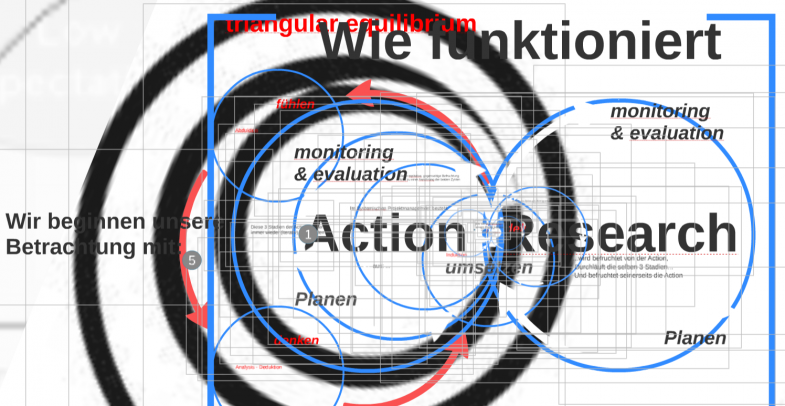
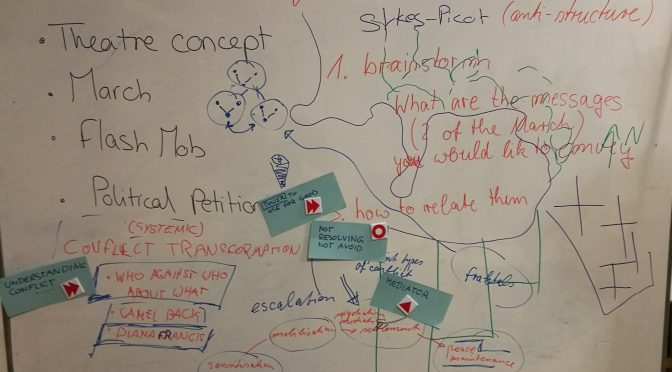
The Rekke is part of an ongoing exercise in curriculum development in conflict transformation. Conflict transformation is thus understood as a cycle of sensitisation / mobilisation, escalation, negotiation, settlement and peace maintenance (similar to the Cycle of Grief or the didactic Model of Complete Action)
Whilst FS has actively affected all those five stages of conflict transformation and can thus be appraised as a practitioner of conflict transformation on his own, the circle of conflict transformation in Croatia and beyond is still ongoing, which is why FS actions shall be continued, replicated and extended.
By proposing a (module in a) curriculum of conflict transformation on FS, I consider this to be both, a tool for peace education as well as part of the (fractal, circular) path of actual conflict transformation. That’s why I call this methodology P.A.R.ts-pro-toto, like in
Project, Action, Results
Participatory Action Research
Tempelhof-Schöneberg for the whole world (local-global-glocal).
The reflexivity of this methodology is given by the related cycle of
Lebens-
werte
entwürfe & wege
Whereas the path of peace was only vaguely projected ahead of the Rekke by engaging with the local population, tourism development and talking the walk, some concrete aims can now be dissected, which serve as windows of opportunity to mainstream a conflict transformation agenda into a (national) curriculum or promote Franjo Starčević among conflict transformation practitioners.
Putting FS on the tourist map of GK:
Goal: To establish Franjo Starčević as a peace figure on Gorski Kotar’s tourist map.
Learning opportunity: FS sites (cemetery, pub, School of Peace, etc.) offer concrete starting points for learning about memory culture in public spaces.
Steps:
Mapping: Digitally and analogically map Franjo-Starčević-relevant sites (using GPS, photos, short texts).
Collaboration: Discussions with tourist offices and civil society actors for joint implementation. Please note, that the ethnographical collection of Mrkopalj is supposed to be moved and may be merged with the collection on Franjo Starčević of Nada Glad. The move may coincide with the 35th anniversary of the decisive meeting of community leaders on 21st September 2027.
Storyline: Development of short, accessible narrative texts for on-site use (e.g., QR codes) – focusing on Franjo Starčević as a mediator, not a saint.
Pilot route: Creation of a prototype (e.g., flyer or app test version) with students or local groups.
Evaluation: Collect visitor feedback – possible integration into larger peace or cultural routes.
Didactic potential: Learning through spatial experience, biographical storytelling, interactive media use, civil society project work.
Reopening the school of peace
Providing for a curriculum in conflict transformation
The Rekke Team is in a good position to advance the memory of Franjo Starčević in this way because it brings together a great variety of people, initiatives and networks, namely:
Walk of Shame, a spin-off of the Civil March for Aleppo and the Dutch initiative “let’s bring them over” as well as yet another spin-off from the latter, the World of Neighbours;
The Walk Peace
Per un mondo…: Hosting summer camps for disadvantaged children…
Bibliography
Otmačić, Valentina.Resisting Inter-Ethnic Violence: Community Approaches to Conflict Transformation in Croatia and Bosnia-Herzegovina. Abingdon: Routledge, 2025. Discusses grassroots approaches to post-war reconciliation and peacebuilding. Central reference for understanding the framework of the Rekke.
Otmačić, Valentina.Škola mira: 30 godina mirovnog obrazovanja u Mrkoplju. [School of Peace: 30 Years of Peace Education in Mrkopalj]. (Publisher TBD). Commemorative volume on the legacy of peace education in Mrkopalj.
Glad, Nada.Goranski mir-ovi. Delnice: Matica hrvatska / Tiskara Marcu, 2017. Ethnographic and historical insight into peace-related narratives and practices in Gorski Kotar, paying homage to Franjo Starčević as a regional figure.
Tourist Office Mrkopalj (Goranka Tuhran).Promotional Video: Hymn for Mrkopalj. YouTube, accessed April 2025. https://youtu.be/ndsuld8v5vQ Cultural framing of the region supported by the European Commission.
Field Notes and Informal Interviews. Conducted April 23–27, 2025, including exchanges with Ljelko (Orthodox Church keykeeper), Andrea (peace educator), local bar owner (Franjo Starčević’s nephew), and Goranka Tuhran.
Regional Memorial Site (Partisan Freeze Site, 1944). Historical location visited on April 27; site of tensioned memory politics between heroism and victimhood.
Personal Communication.
Goranka Tuhran, Mrkopalj Tourism Office
Andrea [Last name TBD], initiator of the Mrkopalj Rekke station
Ljelko [Last name TBD], Orthodox Church keyholder
Nada Glad, local author and ethnographer
SOP
standart operational procedures
P….rogramme
… A …ction: … methodology (toolbox, techniques, tool), organisation, …
… … R.ts-pro-toto.de
Die Sozialpädagogik untersucht die Lehre gesellschaftlicher Gruppen. Die Lehre ist die perpetuierte Darstellung eines dynamischen Systems, heuristically vorgestellt als ein Ei oder auch eine Eizelle, aufgespult bzw. wirksam auf Basis einer 3D-Eulerschen Spirale nach den Gesetzen von Navier-Strokes.
teambuilding, community-building of practice / action,
communications
reporting (who at who/m, optional), internal/external)
protocol, supervision
finances
After discussing with Anna, I would like to propose for the next Walk to create a fund / pool the (minimum) expected expenses beforehand and have one “finance officer” to pay the bills. It should provide for some more planning security to attract new Walkers, greater reliability and transparency and maybe even attract small scale donation / sponsorship. To be expected left-overs can be used to help out friends on the ground in a low-key but united manner. I also think, the Sunday Zoom meeting and it’s facebook messenger group (reactivating / filling with meaning existing structures instead of fragmenting discussions) should be used to discuss and announce respectively this and those issues.
Issues:
* (dynamic) Map of Engagement (from WoS Serbia)
* changing requirements and responses of the Balkanroute
The so-called “New Pact on Migration and Asylum” presented by the EU Commission in September comes as a slap in the face of asylum seekers and refugees still suffering violence and injustice along our borders. It furthermore comes as a slap in the face of those tens of thousands who took to the streets in the past weeks to call for the evacuation of the Greek islands’ camps and for radical change to European migration and asylum policies.
The pact puts returns (i.e. deportations) before the rights of refugees and favours exclusion over protection. There is no plan for a robust solidarity mechanism for the fair relocation of refugees and asylum seekers between European states, while this would be an essential prerequisite for achieving a sustainable decongestion of the Greek islands. The newly proposed “border procedures” will continue to put the responsibility for people seeking protection on countries of first arrival. The pact promotes the creation of new camps in the style of Moria along the borders, which we firmly oppose.
At the same time, there is no even remotely humane and dignified solution for those refugees currently forced to live in camps on the Aegean islands, in Maltese detention centres or anywhere else at the EU’s external borders.
This is why civil society movements and organisations from several European countries call for renewed protests on 15th/16th November. Our wave of solidarity will continue to grow.
Together we are calling on European leaders and the European Commission to act now:
Evacuate “Moria 2.0” and all refugee camps on the Aegean islands. Establish a relocation scheme for all protection seekers arriving at the EU’s external borders.
Stop pretending to wait for a pan-European solution, that never comes. Relocate refugees to other EU member states and provide proper housing, in accordance with the European Convention of Human Rights and the Charter of Fundamental Rights of the European Union.
Put an end to illegal pushbacks at the external borders of the European Union. The EU must not turn away people seeking protection, but must provide safe routes to Europe instead.
Establish an EU-run search and rescue operation in all regions of the Mediterranean.
End the criminalisation of solidarity and humanitarian aid.
Ensure fair asylum procedures for everyone. No decisions based on shady safe third country concepts or average protection rates. No detention of protection seekers.
Implement human rights-based asylum policies that ensure protection, as opposed to exclusion. This requires increased solidarity and responsibility sharing between European countries, and an end to systematic human rights abuses at the borders.
Europeans For Humanity
Europe Must Act
MiGreat
No More Morias
PRO ASYL
Rethinking Refugees – Knowledge and Action
SOSMoria
Vluchtelingencomité Haarlem
Vluchtelingencomité Groningen
Walk of Shame EU
Last update of the signatory list: 16 October 2020
Verwaltung öffentlichen Eigentums: Wer´s braucht, der nimmt sich. Vermögen-s kinetische Energie (Beschäftigung) – potentielle Energie V wie = Wirkungsfunktional Kapitalismus u.a.
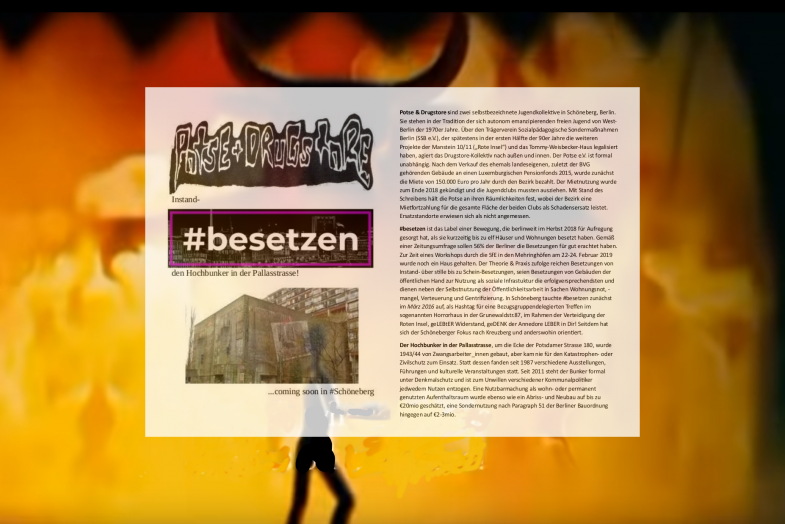
haben das bessere Flächenmanagement:#besetzen
Anarchisten ist das scheiss egal legal, illegal Ikearegal
Subjekt Prozess Wirkung Potse&Drugstore, die autonome Jugendkultur Schoenebergs instand #besetzen den Hochbunker in der Pallasstrasse
der Militarismus…
ist ein früher Aspekt des Etatismus, des Staatswesens. Jede Autonomie beinhaltet kollektive Souveränität über Grund und Boden sowie Steuern und Abgaben. Bildung, Kommunikation und öffentlicher Schienenverkehr sind pan-europäisch regional. Was ich sagen möchte ist, dass das Militär Zuliferer eines reformierten Sozialwesens sein möge, für eine integrierte Beschäftigungspolitik.
Überwachung ist ein Aspekt des Militarismus. Die Verwaltung muss Vorkehrungen treffen, um dem gemeinschaftlichen Kontrollwahn entschieden entgegengetreten zu können…
die dynamik des bildungswesens – bildung für öffentliche Reife (statt privatwirtschaftlichem Trainings) – maths als maßstab der persönlichen entwicklung – …